Will FPGA reign supreme with the rise of 5G?

Without a doubt, 5G is a massive party that the electronics industry can’t wait to join. Buying into the grand vision of “5G changing the world”, everyone wants to jump onto the bandwagon and kick-start a new phase of rapid growth.
In the semiconductor industry, there is every indication that Field-Programmable Gate Arrays (FPGAs) will become a key computing architecture supporting 5G. Some industry seers even claim that “FPGA will reign supreme with the rise of 5G”. They believe that FPGA will dominate 5G signal processing.
So, where exactly did this idea come from?
The three new challenges of 5G
To date, 5G represents the pinnacle of human achievement in the field of mobile communications. However, with its many performance and functional breakthroughs it has brought many challenges. There are three major ones:
• Firstly, the complexity of radio resource management has increased. In order to meet the high speed requirements of tight
spectrum resources, 5G uses Massive MIMO. This requires a more advanced beamforming algorithm, which is bound to
increase the complexity of radio resource management.
• Secondly, it has raised the question of how to manage fronthaul BW. Based on the 4G Common Public Radio Interface (CPRI)
protocol, 5G has introduced XRAN, eCPRI, and ETH protocols. To achieve multi-protocol support and converged access,
sufficient bandwidth is needed, and design resources must support the ever-evolving 5G protocols.
• Thirdly, the increased data transfer rate increases the pressure on real-time processing. With 5G, the data transfer rate is
10 times that of 4G. Such a tremendous amount of data will require much greater processing capabilities.
If we consider these challenges and translate them into requirements for 5G signal processing and computing platforms, we can conclude the following:
• 5G systems are more complex and require more powerful computing support
• Volume, power consumption and cost constraints must also be addressed
• Flexible configurability is necessary to deal with the development of protocols and repeated algorithm calculations
• Self-adjustment according to different scenarios in a smarter way is crucial in improving processing efficiency
According to these requirements, FPGA is indeed a very suitable technology. If it can be further tailored to the requirements of 5G and ultimately redefine itself as a more targeted platform-based product, FPGA may well ascend to the throne of 5G signal processing.
RFSoC platform
In fact, FPGA vendors have long recognized both the challenges and the opportunities, and have already begun to address them and exploit them some time ago. The RFSoC launched by Xilinx in 2017 is a great example of a success story from an early adopter of 5G technology.
As its name suggests, RFSoC is not a purely programmable logic device, but a heterogeneous architecture platform that integrates multiple functional modules. In simple terms, the Zynq FPGA SoC is a heterogeneous architecture platform for theARM+FPGA released by Xilinx. The RFSoC is based on Zynq and further integrates high-performance ADCs and DACs, as well as other dedicated functional circuit modules to constitute an exclusive computing platform for 5G.
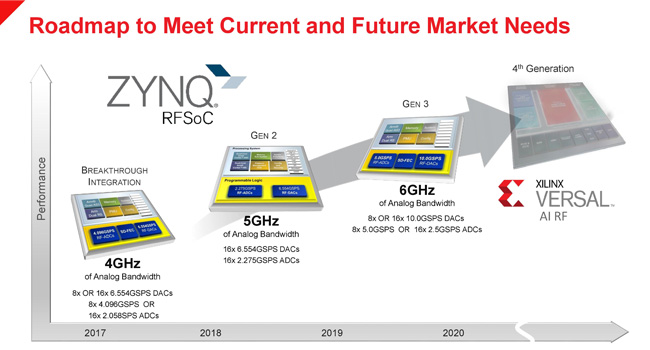
Figure 1. Xilinx RFSoC platform roadmap (Source: Xilinx)
The most immediate benefit of this new architecture is system optimization in terms of power consumption and size. According to Xilinx, by replacing the discrete data converters (ADCs and DACs) with integrated, direct RF sampling technology, RFSoC can reduce power consumption and package size by 50-75%. Thus, high-bandwidth and small-size 5G solutions are easier to explore. At the same time, the obvious flexibility of this fully programmable platform allays the market’s fears that pervaded the early days of 5G deployment.
With the acceleration of 5G commercialization, RFSoC has launched three generations of products in quick succession over just two years. If all goes according to plan, the third-generation RFSoC will be available in the second half of 2019. It will support 8 or 16 10GS/S DACs, and 8 5GS/Sor 16 2.5GS/S ADCs. This can fully enable direct RF sampling in the 6 GHz band or below, and further reduces power consumption by 20%.
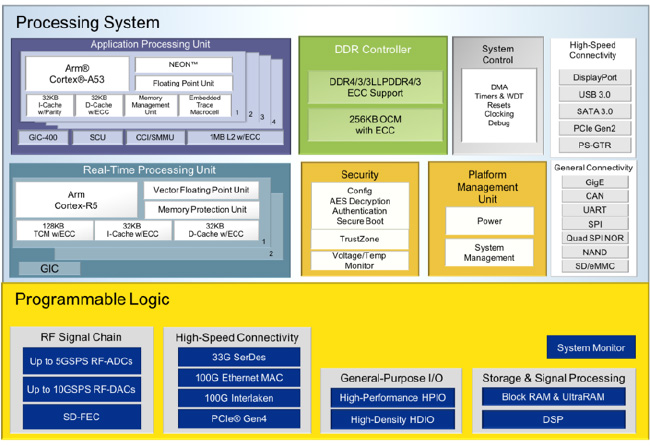
Figure 2. Block diagram of third generation RFSoC platform system (Source: Xilinx
Introduction of AI
That said, in view of the future 5G technology requirements, the current RFSoC is not perfect yet. Under Xilinx’s strategy, the development of the next generation RFSoC has already begun. One of the core targets of the fourth generation RFSoC is to add inference technology such as machine learning to radio, as well as introduce artificial intelligence (AI) technology. This will enable smart judgments based on network and user situations to make the most appropriate response, thereby maximizing the efficiency of signal processing resources.
For example, to make the beamforming algorithm of Massive MIMO more efficient, the machine learning algorithm can be used to optimize the beamforming technology according to the user’s behavior. It will realize more accurate beam delivery by predicting when users will join the network of a certain area, subsequently pre-allocating a beam for each.
However, the existing computing platforms are not able to realize this concept. But, Xilinx’s new adaptive compute acceleration platform (ACAP) architecture can. Based on the latest 7nm semiconductor technology, ACAP integrates multiple computing architectures, such as scalar engine (CPU), self-tuning engine (FPGA), and smart engine (vector processor), in a highly integrated, multi-core, heterogeneous architecture computing platform, to achieve a flexible configuration of hardware in accordance with different workload requirements.
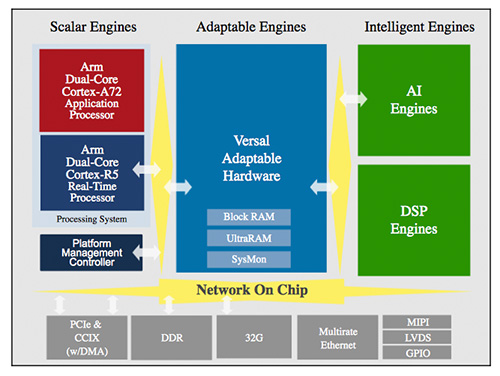
Figure 3. Block diagram of Versal ACAP functions (Source: Xilinx)
A new generation of RFSoC called Versal AI RF will be able to be supported by this kind of platform. According to Xilinx’s calculations, AI’s core engine can combine radio algorithms and AI algorithms. Compared to existing 16nm-based platforms, this new solution can increase the speed performance fivefold. Hence the support for 5G signal processing will be significantly more powerful, inspiring much greater confidence in developers.
Traditionally, the communications industry has been the mainstream application market for FPGAs. With the rise of 5G, FPGAs will no doubt usher in a new wave of development.
So, the question remains – FPGA will reign supreme with the rise of 5G?
Not only market opportunities but also human achievements will ultimately decide whether the question mark at the end of this sentence can be replaced with an exclamation mark. Market insights, cumulative technological advances and ingenuity in product design are all mandatory requirements for anyone hoping to score a VIP ticket to the 5G party. So far, Xilinx’s RFSoC has ticked all the boxes. It cannot be ignored.
See you at the 5G party!

▲TOP
|