| |
Making the leap into everyday life
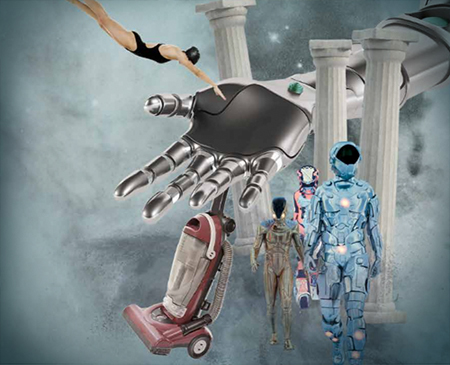
EVEN IN ANCIENT TIMES, PEOPLE HAD
A VISION OF MACHINES THAT WOULD
AUTONOMOUSLY HELP THEM IN THEIR
DAY-TO-DAY LIVES. TODAY, THE SCIENCE
OF ROBOTICS IS ABOUT TO
MAKE THE LEAP FROM INDUSTRY INTO
EVERY AREA OF HUMAN LIFE, SO REALISING
THAT AGE-OLD DREAM.
The ancient Greek scientist and philosopher Aristoteles
wrote in his work “Politics”: “If every tool could
perform its own work when ordered, or by seeing what to
do in advance ... master-craftsmen would have no need of
assistants and masters no need of slaves.” The subsequent
centuries have seen the invention of machines with sometimes
quite astounding capabilities. Such advances came
to a first fruition in the 18th century. In 1740, for example,
Jacques de Vaucanson created an automated duck capable
of flapping its wings and drinking water. He also developed
the first fully automatic weaving loom.
THE ORIGINS OF THE WORD “ROBOT”
The word “robot” was not coined until the 20th century –
in a theatre play, “Rossum’s Universal Robots”, published
in 1920 by Czech author Karel Čapek. The drama is about
artificial humans – robots – who serve as cheap labour, devoid
of all rights, and ultimately rebel against their human
masters. It was not until the 1940s that the word “robot”
really became widespread, however, through the writings
of science-fiction author Isaac Asimov.
Initially used only to describe human-like machines, the
word “robot” today covers a wide range of different machinery.
In fact, it is still not unambiguously defined even
today. A sound basis for judging when a machine can be
described as a robot is provided by the Robotic Industries
Association: “A robot is a programmable, multifunction
manipulator designed to move material, parts, tools, or
specific devices through variable programmed motions for
the performance of a variety of tasks.”
FIRST USE OF ROBOTS IN THE AUTOMOTIVE INDUSTRY
The first robot meeting the above criteria was patented in
the USA in 1954. Georg Devol developed a programmable
manipulator named “Unimate” for gripping and moving
components. After having tried to market his invention
for almost 10 years, he sold the patent to Joseph F. Engelberger.
The
engineer and businessman modified the robot,
and his company Unimation finally succeeded in bringing
it to market, selling 8,500 of the machines in total. And so
it is that Engelberger is regarded as “the father of robotic”.
The numbers of robots employed in factories have been
steadily rising ever since. They peaked in 2015, with some
1.6 million robots in use worldwide. According to the International
Federation of Robotics (IFR), that figure is forecast
to rise to 2.6 million by 2019.
FROM AN INDUSTRIAL WORKER TO A PARTNER IN EVERYDAY LIFE
The rapid advances in sensor and microprocessor technology
in recent years have steadily expanded the robots’
range of abilities. Nowadays they are able to detect objects,
navigate autonomously, sensitively handle objects with their
grippers, and move freely even around difficult terrain. “After
some 50 years of robot use in industry – primarily in
automobile manufacture – we are about to see them make
the leap into wider areas of society,” asserts Professor Ingrid
Ott from the Karlsruhe Institute of Technology. “There
have been major technical advances in robotics in the recent
past. As a result, robots are not only becoming ever smaller,
lighter, cheaper and more flexible to use, they are also increasingly
moving out of the secure areas of industrial mass
production and working directly alongside human beings.”
So-called service robots – assisting in clinical care, handling
logistics, or cleaning business premises and private households
– will “in just a few years attain higher global market
volumes than classic industrial robots. A number of global
corporations are investing huge resources researching robot
assistance systems for all areas of life.” The robots of the
future will not only be strong, fast and precise; they will also
help humans as efficient, communicative partners in their
day-to-day existence.
ROBOTS LEARNING TO FEEL
According to Professor Dr Martin Venhaus, Head of the robotics,
image processing, computer-aided data processing
and sensor technology labs at the Sudwestfalen university of
applied sciences, robot technology is also being increasingly
integrated into other products. “I am seeing the dividing line
steadily disappear. A good example is automated driving,”
Venhaus reports. The university is looking to work on the
voice and gesture recognition capabilities of robots in future.
3D imaging and smartphone interfacing will also be subjects
for research. “And not least, we want to teach our robots
to feel, enabling even closer human-machine interaction,”
says Venhaus. To that end, robots will in future increasingly
be equipped with artificial intelligence. That will mean they
will be able to recognise and interpret human emotions, and
also make their own decisions. Then robots will be capable
of working truly autonomously, with no human intervention
– and the vision of Aristoteles will have become reality.

▲TOP
|
|
|
